Papers brief: Korean Go TV shows AI winrates — then stops saying “AI”
arXiv decade study of ~1,900 hours of Korean Go YouTube finds AI graphs everywhere while explicit AI talk shrinks — domestication of machine judgment.
Source: arXiv
Paper
When AI Becomes Routine: A Decade of Public AI Mediation in Korean Go Commentary — Haewoon Kwak (submitted 30 Jul 2026)
ID: arXiv:2607.28332
What it claims
After machines beat elite humans, the live question is how machine judgment becomes publicly intelligible and attributable. This study tracks Korean Go (baduk) commentary on YouTube across a decade (2016–2025), about 1,900 hours of institutional and creator channels, in four phases of AI availability (e.g. KataGo after AlphaGo).
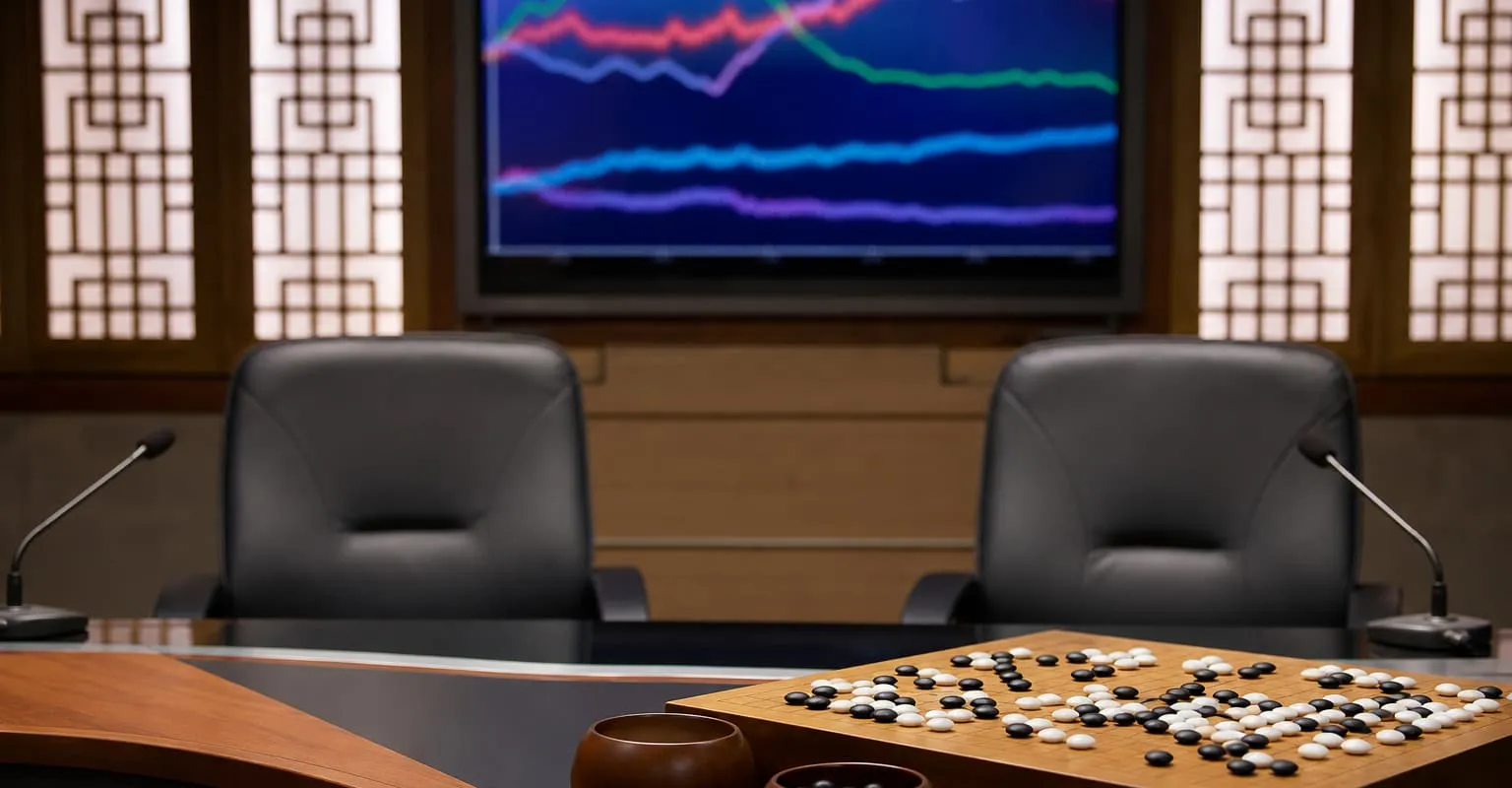
A late-period asymmetry: AI winrate graphs are visible for about 98% of institutional broadcast time, yet AI-salient talk is only 2.63% of sentences. Winrate and point-gap talk persist while the word “AI” recedes — read as the communicative signature of domestication. Creator-led commentary leans further into interface rendering than institutional talk. The author typologizes source-foregrounding vs source-receding mediation and argues they preserve different hooks for audiences to contest the machine. Stakes rise in domains where AI is less reliable than Go.
The breakdown
The decade corpus (~1,900 hours, 2016–2025) lets the author watch AI move from novelty to furniture. The late-period numbers are the brief’s spine: winrate graphics on screen about 98% of institutional broadcast time, but AI-salient talk in only 2.63% of sentences. Metrics stay; the source label thins. That is domestication as communication design. Creator channels lean harder into interface rendering than institutional desks — useful when you ask who still teaches audiences to say “the engine,” not only to read a curve. The typology (source-foregrounding vs source-receding) is the portable tool for any AI meter in public.
Why readers outside the lab should care
Korea’s Go broadcast culture is an early warning for any public AI dashboard — finance apps, navigation, medical triage UIs — where numbers stay on screen while the source label vanishes. Expats watching Korean sports media, and product teams shipping “winrate-like” meters, should ask: can a viewer still name and challenge the model? When the meter is trusted more than the word “AI,” contestability dies quietly.
Product designers shipping confidence meters into Korean consumer apps should treat this Go corpus as a cautionary timeline of label fade.
What travelers and expats should watch
- Do notice when Korean (or any) AI UIs show scores without naming the system — that is source-receding mediation.
- Do prefer products that keep a discursive anchor (“this is model X’s estimate”) when stakes exceed a board game.
- Don’t treat Go’s high AI reliability as license for the same silence in weaker domains.
- Expect corpus limits: YouTube Go commentary is the case, not every Korean AI surface.
- Do practice naming the system aloud when a Korean broadcast or app shows only a meter — keep the contestability hook warm.
Context
Read this as a media-literacy paper about domestication, not as a KataGo review. Korelay frame: when AI is routine, the danger is not absence of graphs — it is graphs without a speakable source. Carry that habit into Korean fintech, navigation, and workplace copilots: if you cannot name the system, you cannot contest it.
Source
arXiv:2607.28332 — abstract and framing cited; open the OA PDF for phase definitions, coding, and typology. Do not republish the PDF.