Korea society brief: DMZ mine blast, Kim Yo-jong’s border wall, and the two-state freeze
A Ddanzi analysis ties a September western DMZ mine explosion to North Korea’s southern-border fortification drive and the 2023 hostile two-states doctrine — what residents and alliance watchers should read into it.
Source: Ddanzi
What happened
According to Ddanzi columnist Pender, on Sept. 21, 2026, soldiers from a direct-search battalion on the western front DMZ were injured when mines detonated during a search mission. The battalion commander and one other officer — two officers in total, including the commander — were seriously hurt, and 16 additional troops were injured.
North Korea denied responsibility, reacted angrily, and followed with a ballistic-missile test launch — a posture the author reads as defiance rather than contrition.
The breakdown
Pender argues the timing fits a pattern: Pyongyang’s provocations rarely stop at one incident, and this one lands amid “southern border permanentization construction” — barrier work North Korea presents as sovereignty, not war preparation.
Three threads run through the piece:
Negotiating leverage. With a year-end U.S.–North Korea summit widely expected, Pyongyang may be building pressure cards — inter-Korean tension and asymmetric military moves — before any table opens.
Defection pressure on the line. Crossings through the DMZ have ticked up as the China–Thailand–South Korea route tightened after COVID-era surveillance expanded. Pender cites a 2024 North Korean sergeant who crossed through a mined belt, a July 2025 civilian who crossed the MDL, and a June 2026 soldier on the central front.
The 2023 “hostile two states” turn. At a Dec. 30, 2023 Workers’ Party plenary, Kim Jong Un declared ties were no longer ethnic kinship but “hostile two states” and “two belligerents at war.” From January 2024, North Korea rewrote propaganda, severed Gyeongui and East Sea cross-border links, and amended its constitution to describe territory bordered by China and Russia north and the Republic of Korea south.
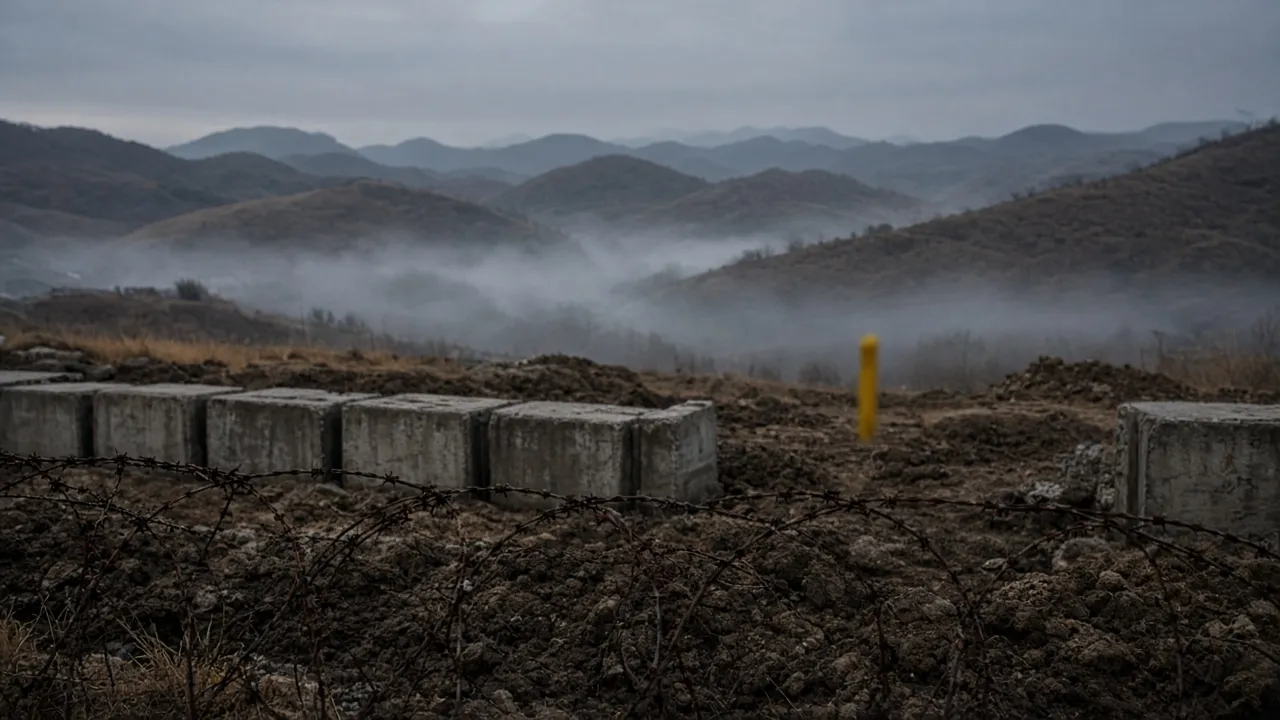
On Sept. 29, Kim Yo Jong said the military had spent two years building “blocking structures” along the southern border as a “pure sovereignty exercise” and claimed soldiers “never once crossed the border line.” After the constitutional shift the MDL functions as Pyongyang’s de facto territorial edge — even though the line is not precisely fixed everywhere.
Ddanzi also notes 50-plus clashes over the summer before Sept. 21, with warning broadcasts and fire exchanged. South Korea’s Lee Jae Myung government answered the two-states doctrine with a white paper on “peaceful two-state relations aimed at unification,” though Unification Minister Jeong Dong-yong drew criticism after suggesting that formula might become official policy, then walking it back.
Why it matters outside Korea
Washington’s summit calendar, Seoul’s constitutional claim to the whole peninsula, and Pyongyang’s new territorial language do not stay inside Korean textbooks. Alliance planners must reconcile the 1953 armistice line, North Korea’s 2024 constitution, and South Korea’s Article 3 territory clause — and miscalculation near an imprecise MDL escalates faster when both capitals describe each other as belligerent states.
What travelers and expats should watch
- Do not treat DMZ tour cancellations as the only risk signal. Pender emphasizes active fortification and repeated low-level clashes on the western sector. If you live near Paju or Yeoncheon, monitor Emergency Ready and local civil-defense notices rather than English wire summaries alone.
- Separate missile tests from mine incidents. The Sept. 21 injuries and the follow-on launch are linked in Pyongyang’s messaging but differ in practical impact: mines affect border-adjacent terrain; missiles trigger national alert apps. Conflating them breeds bad risk calls.
- Track summit-season rhetoric. If U.S.–North Korea meeting talk intensifies toward year-end, expect more provocations framed as sovereignty — barriers, denials, tests — rather than a single accident narrative.
Context
Read this as a political reading of border fortification tied to the two-states doctrine, not as a confirmed order-of-battle dossier or proof that every DMZ injury triggers war. Ddanzi’s value is connective tissue: defection routes shifting toward the DMZ, Kim Yo-jong’s sovereignty framing, and leverage-building before diplomacy.
Source
Ddanzi: 북한의 비무장지대 지뢰도발에 관하여: 지금의 남북관계, 그리고 <남부 국경 영구화 공사> — Korean original analysis by Pender; paraphrased for briefing; read the original for full detail.