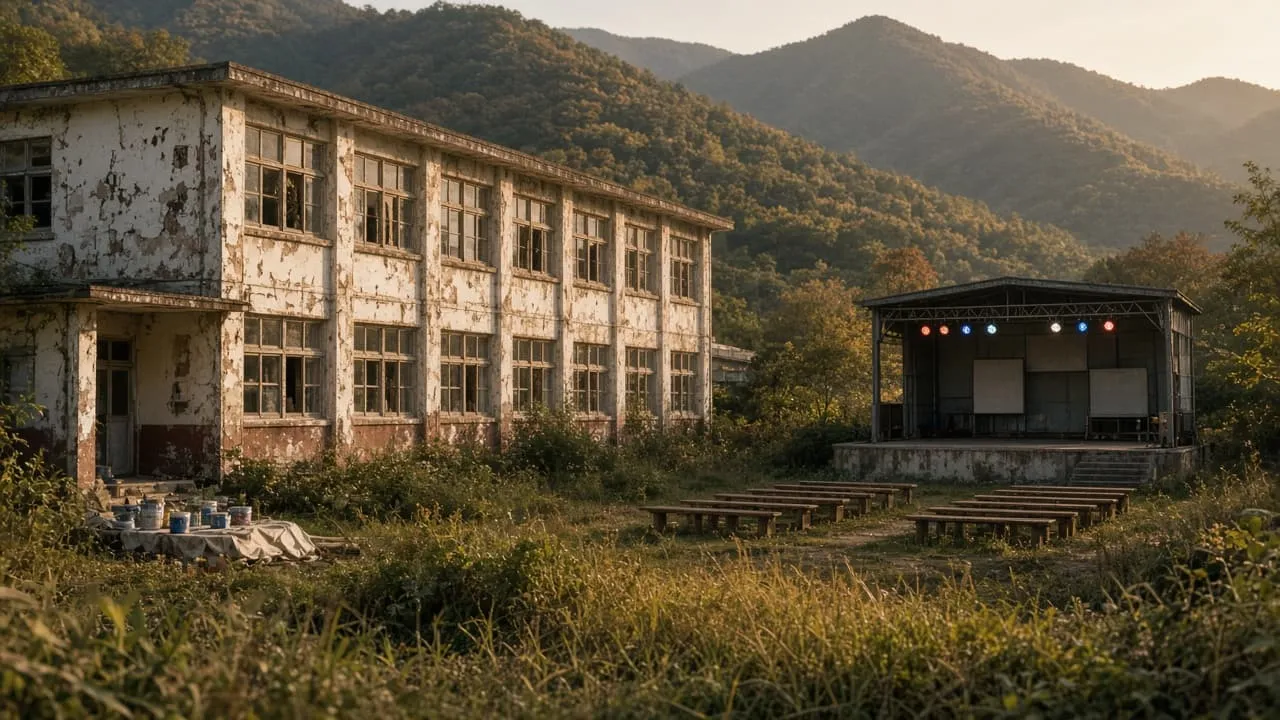
Korea culture brief: Yeongju youth turn abandoned school into Sobaeksan Arts Village
Dong-A Ilbo profiles Cloud Cultures CEO Jo Guk-won, who cleared 150 tons of waste from a closed Isan-myeon school, won ten years of free use, and is building a Ministry-backed youth village where rural artists can earn and stay.
Source: Dong-A Ilbo · 문화연예
What happened
According to Dong-A Ilbo, Jo Guk-won, CEO of Cloud Cultures, is turning a closed elementary school in Isan-myeon, Yeongju, North Gyeongsang into Sobaeksan Arts Village — a hub where young artists can live, work, and get paid without leaving the countryside. Published September 19, 2026, the piece is episode 34 of Dong-A’s “There Are Youth in That Village” series on regional depopulation.
Jo told Dong-A that converting the campus required hauling away 150 tons of trash, fixing broken water and drainage, and roughly one year of cleanup. Facility work has cost about 100 million won so far — far below the billions of won contractors warned a commercial rehab would need. The Ministry of Interior and Safety designated the site a youth village (청년마을) this year.
The breakdown
Dong-A traces a forced move and a community rescue:
- Original base (2002–2024): Jo’s father, village chief Jo Jae-hyeon, ran the arts village in Buksok-myeon on co-owned land. A sudden 2024 sale forced Cloud Cultures out that winter.
- New site: Residents organized in a chat group to find space. A regional business linked to a former Yeongju mayor owned the Isan-myeon school, closed around 1998, briefly an English village in 2006, then abandoned. The owner granted ten years of free use.
- Jo’s path: A musical and theater director from Seoul and Daehak-ro, Jo returned in 2019 after his father’s sudden death. Weekly workshops built a core team; two task-force members have stayed since 2019.
- Revenue loop: Cloud Cultures added festival planning, merchandise, and experience products, funneling profit back into performances that do not break even on tickets alone.
- Youth-village programs: “Our Neighborhood Art Distribution Center” pays local artists through culture jobs; Wednesday musical classes draw about 20 people. “Liveable Dream” adds modular theater, dormitories, and empty downtown houses for resident artists.
- Payroll: Jo’s 2025 productions paid artists roughly 150–200 million won, but most wages still went to non-local hires; Cloud Cultures plans to prioritize artists settling in Yeongju. The cafe is open; the “Oi Project” platform will aggregate local show listings.
Why it matters outside Korea
Korea’s rural hollow-out debate usually centers on factories or tourism vouchers. Dong-A’s Yeongju case shows reuse of dead public infrastructure — closed schools and empty downtown units — as artist housing plus earned-income pipelines, with central youth-village backing. For anyone comparing Japan’s empty-house residencies or U.S. Rust Belt theater conversions, Yeongju tests whether ~100 million won of grassroots cleanup can substitute for contractor-scale capital while still moving real payroll.
What travelers and expats should watch
- Plan overnight, not a Seoul day trip: The village is about ten minutes from town by car, but evening show setup can eat one to two hours each way.
- Expect village-scale Korean programming: Classes and the Romanticism Festival mix community education with performance — check Cloud Cultures channels before visiting.
- Infrastructure is mid-build: Water, drainage, modular theater, and dormitories were unfinished at reporting time; treat visits as a work-in-progress cultural lab, not a polished resort center.
Context
Read this as a depopulation fight built on trash removal, free land tenure, and payroll engineering — not a government-built K-culture theme park or a Seoul touring company’s rural pop-up. Dong-A’s through-line is Jo’s line that “if there is no arts market, create one”: the insight is that keeping artists in Yeongju requires a revenue stack wider than ticket sales, and that 150 tons of garbage cleared by hand is the unglamorous price of turning a 1990s closed school into a place where children might watch a show while parents sit in the cafe — the modest future Jo says he actually wants.
Source
Dong-A Ilbo · 문화연예: “영주에 문화시장을 만들자!…폐교 살려 예술가 불러들인 청년 이야기” — Korean original; trash tonnage, costs, timelines, program names, youth-village designation, and Jo quotations from Dong-A; paraphrased for briefing; read the original for photos and full Korean text.