Korea business brief: KOSPI's second-day plunge below 6,000
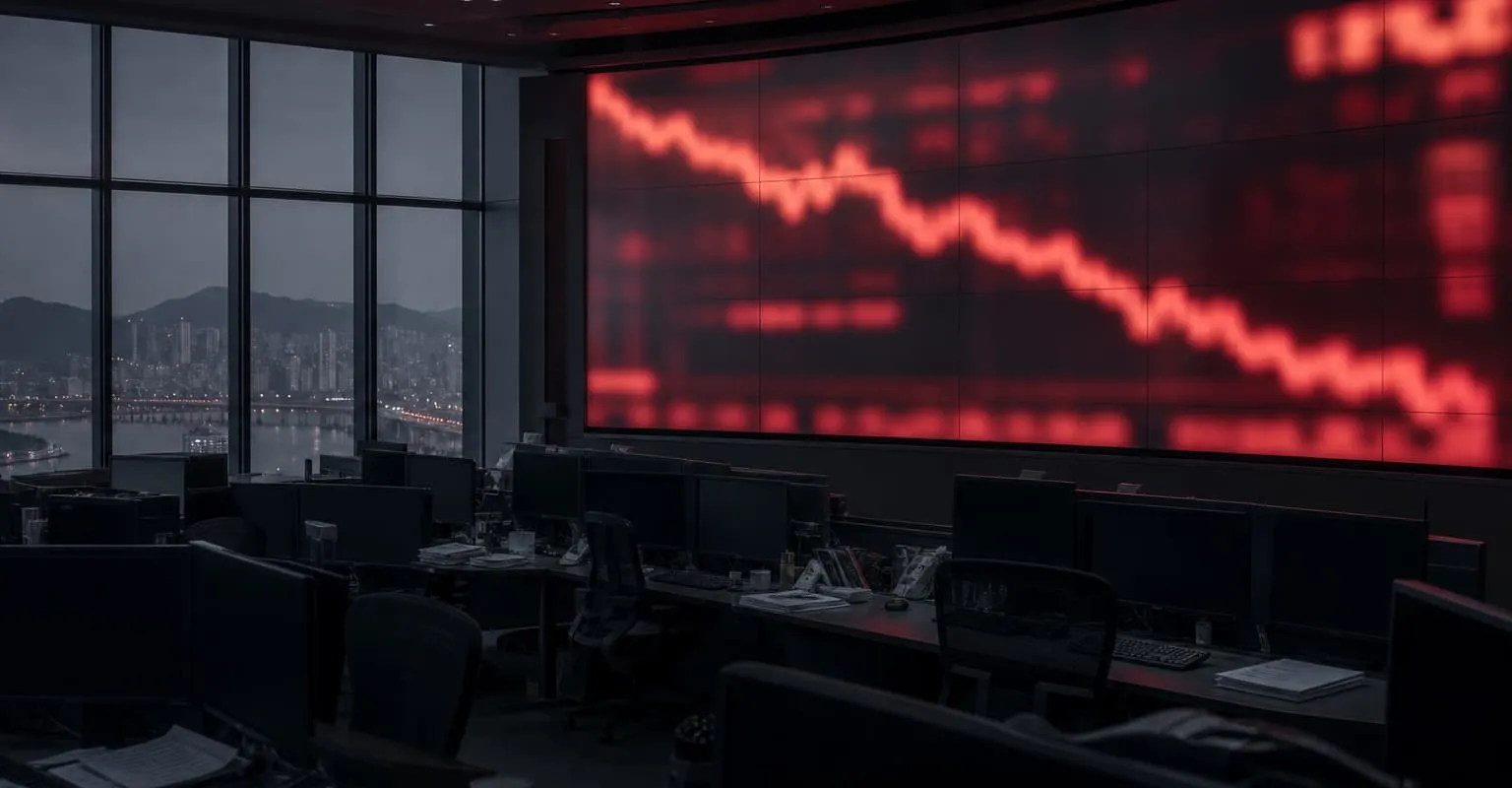
After Black Tuesday, KOSPI closed 5,663.24 (-5.98%) as retail flipped to selling and both boards hit circuit breakers again.
Source: The Korea Times
What happened
This is the day-two sequel to Tuesday’s crash, not a second copy of the same brief. Korea’s KOSPI finished Wednesday at 5,663.24, down 5.98%, staying below 6,000 for a second consecutive session after Tuesday’s 10.84% drop, The Korea Times reported.
The path mattered. The index opened at 6,089.11, briefly reached 6,228.52, then fell to the 5,200 level before paring some losses. A sell-side sidecar hit at 9:06 a.m.; a circuit breaker followed at 12:32 p.m. Kosdaq fell 6.12% to 662.68, with a sidecar at 9:14 a.m. and a circuit breaker at 12:19 p.m. Times said it was the first time circuit breakers fired on both boards for two consecutive sessions.
The breakdown
The flow flip is the new fact. Foreign investors sold a net 764.4 billion won ($527.8 million). Retail investors, net buyers of about 4.3 trillion won on Tuesday, sold a net 2.93 trillion won on Wednesday. Institutions bought a net 3.61 trillion won and still could not stop the slide.
Chip names again led. SK hynix fell 9.61% to 1,401,000 won (22.85% over two days). Samsung Electronics fell 5.23% to 208,500 won. SK hynix’s record quarterly operating profit of 60.54 trillion won still missed expectations and offered no concrete shareholder-return plan on the call — enough to keep selling alive. Company contracts, capex, and the consensus miss are covered in Korelay’s companion SK hynix earnings brief; this piece stays on the tape.
Overseas peers were weaker in chips but not Korea-scale weak. The Philadelphia Semiconductor Index fell 4.49% overnight; Nikkei −2.81%, TAIEX −4.65%, CSI 300 −0.53%. The S&P 500 rose 0.21%; Nasdaq slipped 0.22%. Iran’s reported tanker seizures in the Strait of Hormuz and a U.S. Federal Reserve decision due Thursday morning (local time) added risk-off noise. From its June 19 all-time intraday high, KOSPI is down 39.7%; July alone is more than 31.8%, larger than the monthly drop Times cited for the 1997–98 Asian financial crisis — a scale comparison, not a crisis diagnosis.
Why it matters outside Korea
For Korea-touching portfolios and employers, Wednesday answers a different question than Tuesday. Tuesday asked whether AI/chip skepticism could force a historic one-day crash. Wednesday asks whether the sell-off is becoming self-reinforcing after retail stopped absorbing foreign selling. Kiwoom Securities analyst Han Ji-young called the plunge abnormal while noting few clear signs of a classic systemic crisis. The won strengthened 15.8 won to 1,446.7 per dollar — again opposite the equity tape.
Leverage and single-stock ETF structure still matter as background, but the deposit-rule and FSC-cap watches belong to Korelay’s July 28 Black Tuesday brief. Do not re-trade that checklist here; watch whether Wednesday’s retail selling and consecutive circuit breakers continue.
What travelers and expats should watch
- Re-check large won conversions on the day: Wednesday’s stronger won ran against the equity plunge — do not assume crash days mean a weaker currency.
- Treat “day two” as a different risk: if you held through Tuesday hoping retail would keep buying, Wednesday’s 2.93 trillion won retail net selling is the update.
- Do not read circuit breakers as shipment stops: they are trading safeguards. Procurement and payroll plans should wait on company guidance and the Fed decision, not on halt headlines alone.
- For ETF deposit and leverage rules: use the July 28 brief; this sequel is about flows and consecutive safeguards.
Context
Read this as a day-two sequel — retail flipped, both boards hit consecutive circuit breakers, and the July drawdown widened — not as a rewrite of Black Tuesday’s leverage-rules story. The useful Korelay split: July 28 = structure and first crash; July 29 = whether the unwind is feeding on itself. Nomura’s Cindy Park argued a later re-rating could follow deleveraging and buybacks; that is an analyst view, not a trade instruction.
Korelay take
Read this as a day-two sequel — retail flipped, both boards hit consecutive circuit breakers, and the July drawdown widened — not as a rewrite of Black Tuesday’s leverage-rules story. The useful Korelay split: July 28 = structure and first crash; July 29 = whether the unwind is feeding on itself. Nomura’s Cindy Park argued a later re-rating could follow deleveraging and buybacks; that is an analyst view, not a trade instruction.
Editor note: Desk reporting supplies the timeline; Korelay adds the overseas behavior layer (what to change, what not to assume, what to re-check). If you only need the wire facts, open the primary link in Source.
Source
The Korea Times: Seoul stocks plunge for 2nd day amid growing panic sell-off — paraphrased for briefing; read the original for full detail.