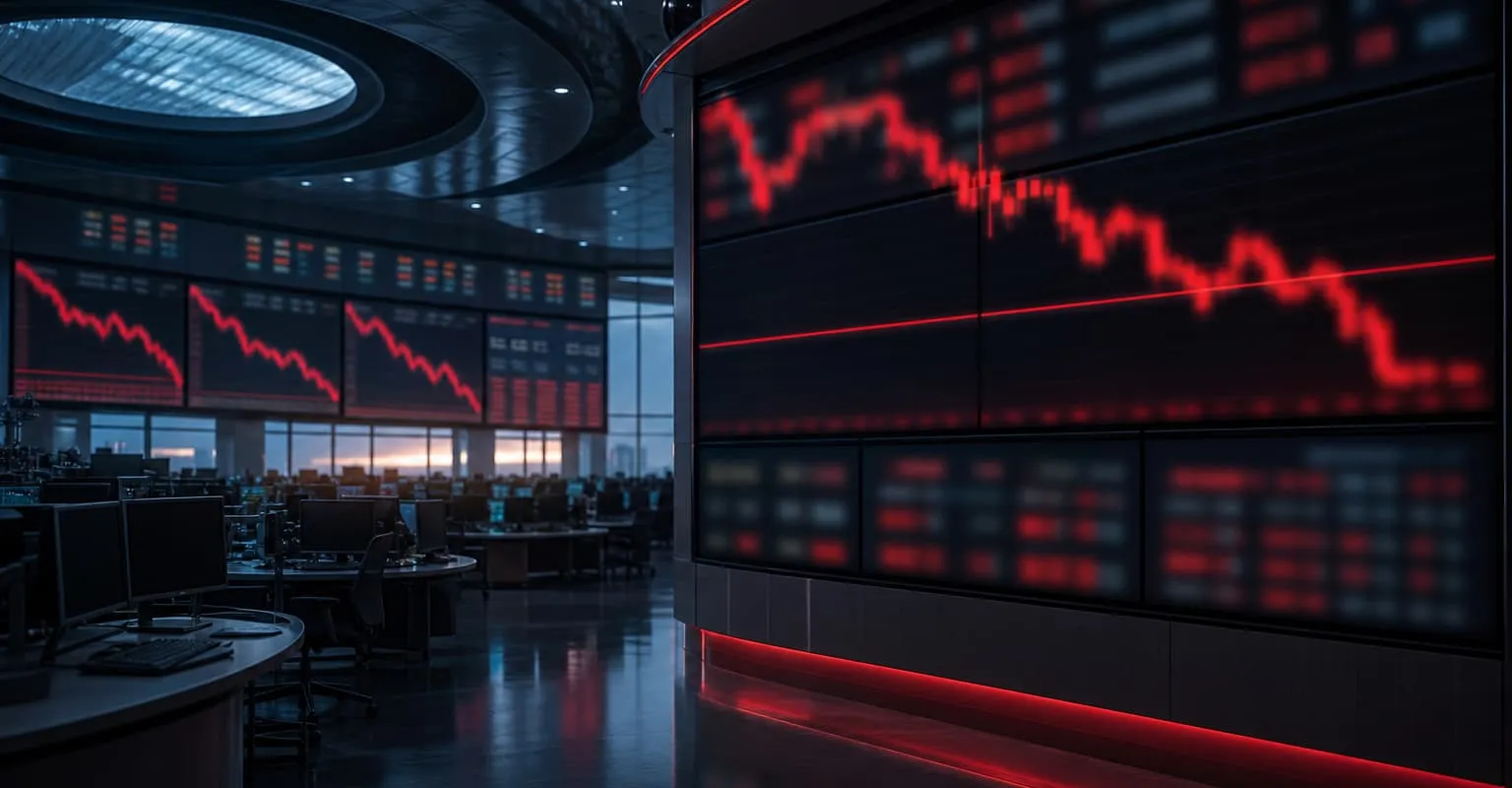
Korea business brief: KOSPI breaks 6500 at the open as sell sidecar fires
Sisa Journal's breaking alert on August 19 says KOSPI plunged in the 5% range right after the open, breaching the 6500 line and triggering Korea's sell-side sidecar.
Source: Sisa Journal · 경제
What happened
According to Sisa Journal, Korea’s benchmark stock index opened Wednesday, August 19 in crisis mode. The outlet published a breaking alert at 9:11 a.m. headlined as a 5%-range plunge on the KOSPI, with Korea’s exchange operator activating a sell sidecar — a temporary curb on automated program sell orders when futures fall hard enough at the open.
The desk subheading narrows the timing: right after the opening bell, the 6500 line broke. That is the only index handle Sisa Journal names in this flash. A photo caption notes KOSPI and KOSDAQ readings on dealing-room screens at Hana Bank headquarters in Jung-gu, Seoul the same morning — both main boards in motion, not a single-index glitch.
This is a headline-speed alert, not a close-of-day wrap. The published body read for this brief carries no closing levels, flow tables, or individual stock moves.
The breakdown
Three facts stack in Sisa Journal’s alert:
- Magnitude: the KOSPI fell in the 5% range — Korean 5%대 means a drop on the order of five percent or slightly beyond.
- Timing: damage arrived immediately after the open. 6500 is the only numbered level in the subheading.
- Structure: a sell sidecar fired — the bourse temporarily suspends certain program sell flows to slow cascading futures-linked selling. It slows the tape; it does not guarantee a rebound.
The piece does not say how long the sidecar lasted or whether KOSDAQ triggered its own curb. The headline focuses on the KOSPI plunge and sell-side halt; the caption confirms both indices were live on Seoul screens.
For overseas readers, the distinction is open shock versus close verdict. A 6500 breach at the bell, a 5%-range drop, and an early sell sidecar describe a violent opening tape — not where foreigners, institutions, or retail finished the day.
Why it matters outside Korea
Anyone holding Korea ETFs, Korea-listed equity compensation, or won-linked remittance plans should treat August 19 morning as a risk-off open. A 5%-range drop that breaks 6500 at the bell can gap Korea ADRs and overnight futures even when U.S. markets looked calm the prior night.
The sell sidecar signals the exchange saw enough program sell pressure to invoke safeguards within minutes — opening-mechanism stress, not proof of recovery.
Because the alert landed 9:11 a.m. on a Wednesday, Asia was still setting tone before Europe and the Americas rotated in.
What travelers and expats should watch
- Do not lock large won conversions on the headline alone: Sisa Journal confirms a 5%-range drop and a 6500 breach at the open, not where the won closed. Check the live USD/KRW print before a big transfer.
- Brokerage apps and limit orders: a sell sidecar pauses program sells, not the whole market. Expect wider spreads and delayed fills for a few minutes after the open.
- Treat “6500 broken at the open” as a volatility flag, not a floor: opening round-number breaks often whipsaw intraday. Wait for a fuller session picture this source does not yet provide.
- No personalized buy/sell call: market-structure brief tied to a breaking alert, not investment advice.
Context
Read this as an opening-bell shock with exchange safeguards engaged, not as proof that 6500 defines the week. Sisa Journal’s stack: Aug 19 / 9:11 a.m. / KOSPI down in the 5% range / 6500 breached right after the open / sell sidecar activated / KOSPI and KOSDAQ on Seoul dealing-room screens. The non-wire insight: when a major desk publishes only a subheading, a photo, and a sidecar flag, you are still in the first minutes — re-rate intraday risk and order execution, not headline levels as settled value.
Source
Sisa Journal: [속보] 코스피 5%대 급락…매도 사이드카 발동 — Korean breaking alert; paraphrased for briefing; read the original for updates as the session develops.